
Custom Sterling Silver Jewelry: Casting and Stone Setting
Casting decides the shape and setting decides whether the shape survives. TTT Jewelry runs eight factory steps from concept to delivery, quotes 25–30 days for a master sample and 21–28 days for bulk, and inspects 100% of finished pieces before dispatch.

Key takeaways
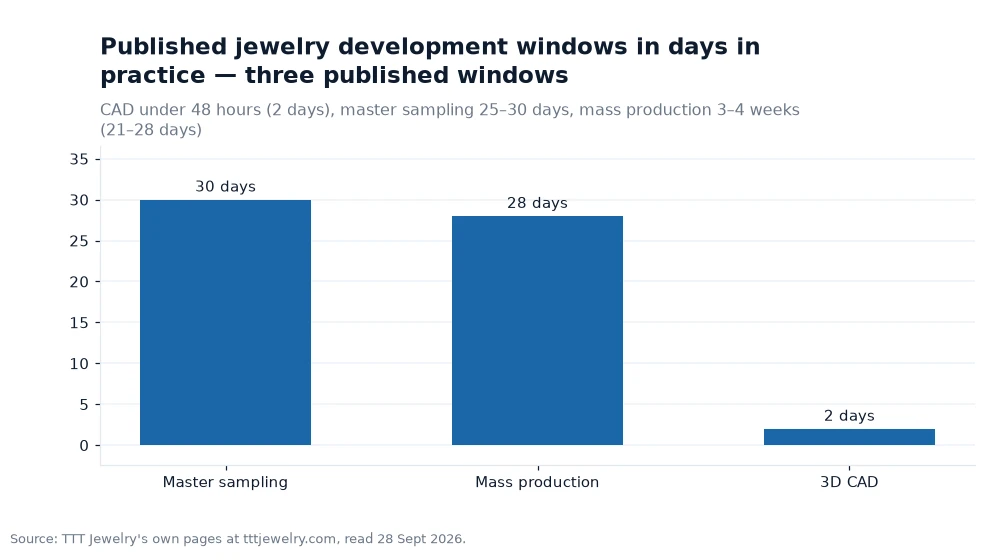
- A master sample takes 25–30 days, which is 3.6 to 4.3 weeks on a seven-day count.
- Setting is a bench operation, so stone count drives labour more directly than metal weight does.
- Prong, bezel, pavé and channel settings fail in different places and need different inspection checks.
- Porous stones and plating baths do not mix, which forces a sequencing decision on every design.
From wax tree to cut sprue
Silver casting starts with a model. The published flow begins with concept design by hand and CAD, then prototyping by mould or 3D printing, and the prototype is what the production mould is built from. In lost-wax casting, wax replicas are attached to a central tree, invested in a plaster cylinder, and burned out so that molten metal can take their place.
The tree matters commercially. Pieces are ganged on one sprue so that a single pour fills many cavities, and the arrangement determines whether thin sections fill before the metal cools. A ring with a 1 mm shank and a heavy signet top will not fill evenly if both are hung at the same height, which is a modelling decision made long before anyone sees a sample.
After casting comes sprue cutting. Each piece is clipped from the tree, the gate is filed flush, and the surface is prepared for polishing. A gate left slightly proud becomes a flat spot that polishing cannot remove without changing the profile, and that flat spot will be visible after plating.
Buyers evaluating a programme should ask how the tree is laid out for their design rather than how many pieces fit on it. Metal yield per tree is a factory metric; fill quality per cavity is the buyer's concern. Buyers who want to see that layout before committing should choose a sterling silver jewelry supplier China that welcomes a factory visit.
Four settings, four failure modes
A setting is a mechanical promise that a stone will stay in place. The promise is kept by metal tension, by a bezel wall, by a drilled seat or by a channel, and each method has a characteristic way of failing.
| Setting | Stones it suits | Bench demand | Typical failure |
|---|---|---|---|
| Prong | Single large CZ, birthstone, pearl in a cup | Prong tips raised and dressed by hand | A prong catches on knitwear and lifts |
| Bezel | Round or oval cabochon, turquoise | Wall rolled evenly around the girdle | Uneven pressure cracks a brittle stone |
| Pavé | Small CZ in a cluster | Seats drilled to depth, beads raised | One bead short leaves a stone loose |
| Channel | Baguette or square stones in a row | Groove cut to consistent width | Gap at the end lets the last stone slide |
Prong settings are the most repairable and the most exposed. A prong is a small hook of metal, and it is the part of the piece most likely to meet a scarf. Bezel settings protect the stone but demand even pressure, because a cabochon that is brittle will crack under a wall that is rolled harder on one side.
Pavé is where inspection earns its keep. A cluster of twenty small stones has twenty beads, and one bead that is short will not show in a photograph. This is exactly the kind of defect that 100% inspection catches and sampling misses.
Stone choice rewrites the casting plan
Not every stone can be set after casting. Heat-sensitive material has to stay out of the burnout and casting cycle entirely, which means the metal is finished first and the stone is added at the bench. Pearls, turquoise and many natural stones fall into that category; CZ and most birthstone synthetics tolerate more heat but still need a seat that matches their exact dimensions.
The dimensions are the quiet problem. A 5 mm stone is not 5.00 mm, and a seat cut to a nominal size will either grip too tightly and chip the girdle or sit loose and rattle. Buyers supplying their own stones should send a sample lot rather than a specification sheet, because the seat is cut to the stone in hand.
Casting also constrains the seat. A seat that is cast rather than drilled saves bench time but leaves a rougher surface and less control over depth. Where the design allows, a cast seat plus a light drill pass gives both speed and accuracy, and the CAD model has to leave enough metal for that pass.
Stone count then drives the schedule. A ring with one 6 mm stone is a few minutes at the bench; a band with forty 1.2 mm stones is an afternoon. Two designs with the same metal weight can differ by a factor of ten in setting labour, and the production quote should reflect that rather than averaging it away. Buyers who plan a custom jewelry wholesale range should state the stone count on the brief, because it moves the quote more than the silver weight does.
Setting before or after plating
The order of setting and plating is a genuine trade-off, not a house rule. Plate first, then set: the stone never enters a bath, but the setting tools can scratch the finish and the prongs end up bright metal against a plated body. Set first, then plate: the prongs and the seat are covered, but the stone has to survive the chemistry.
For CZ the second route is common, because the material tolerates the process and the plated prongs look uniform. For pearls and porous stones the first route is the only sensible one, and the plated body has to be protected during setting with tape or a soft jaw.
There is a third option that buyers rarely specify: plate, set, then touch up the prongs with a localized finish. It costs an extra handling step and gives the most consistent look on high-value pieces, where a bright prong against a plated shank is the first thing a retailer notices.
Whichever route is chosen, the decision should appear on the design sheet, and the same applies to every 925 sterling silver piece in a range rather than only to the hero design. A factory that receives no instruction will choose the route that suits its bench flow, which may not be the route that suits the stone.
Worked example
Take a pendant with one 6 mm CZ in a four-prong setting and a matching band with twenty-four 1.2 mm stones in pavé. Both use the same 925 silver and both sit inside the MOQ of 50 pieces per design, so the order is 2 × 50 = 100 pieces.
Timing is shared up to the bench. CAD takes under 48 hours, or 2 days; sampling takes 25–30 days; bulk takes 21–28 days. The total is 2 + 25–30 + 21–28 = 48–60 days, which is roughly 7 to 9 weeks for either design.
Convert the sample window to weeks for a retail calendar: 25 days is 25/7 = 3.6 weeks, and 30 days is 30/7 = 4.3 weeks. A launch dated nine weeks out has no slack for a second sample, because one extra cycle adds another 3.6 to 4.3 weeks.
Now count the setting work. The pendant has four prongs per piece, so 50 pieces means 200 prongs. The band has 24 stones per piece, so 50 pieces means 1,200 seats and 1,200 beads. The two designs share a casting schedule and do not share a bench load, and that asymmetry is what a per-design timeline hides.
Frequently asked questions
Should stones be set before or after silver plating?
It depends on the stone: CZ usually tolerates plating after setting, while pearls and porous stones must be set after plating so they never enter the bath.
How long does a cast and set silver sample take?
The published master sampling window is 25–30 days, or 3.6 to 4.3 weeks, and it covers casting, finishing and stone setting.
Why does stone count affect the production schedule?
Setting is manual bench work, so a pavé band with 24 stones takes far longer to complete than a single-stone pendant even when the metal weight is similar.
Writing a design sheet the bench can follow
Put the setting type, the stone dimensions, the seat depth and the plating sequence on one page. The bench does not need a mood board; it needs to know which stone goes in which seat and whether the piece is plated before or after.
Ask for the inspection record at the same time as the shipment, because a loose stone is a return that costs more than the piece. A programme built on factory direct manufacturing should be able to show the check that caught it before packing.
Casting and setting are old crafts with modern tolerances. The published timelines are achievable when the model is right, the seats are cut to real stones and the plating order is decided early. They become optimistic when any of those three is left to the bench.
Source note: figures come from the manufacturer's own website (tttjewelry.com), read 28 Sept 2026.[1]