
Timeline and Lead Times With a Full-Service Partner for a Pharmacy Line
A full-service fragrance partner covers more of the calendar, but it does not shorten the calendar by itself. For a pharmacy own-label range, the schedule is set by how quickly a brief can be approved, how many sample rounds are needed, how long components take and how much documentation has to be assembled before the goods can ship. Bringing development, packaging, filling and paperwork under one roof removes the handovers between suppliers, which is where most of the avoidable delay sits; the phases themselves still have to run.
Key takeaways
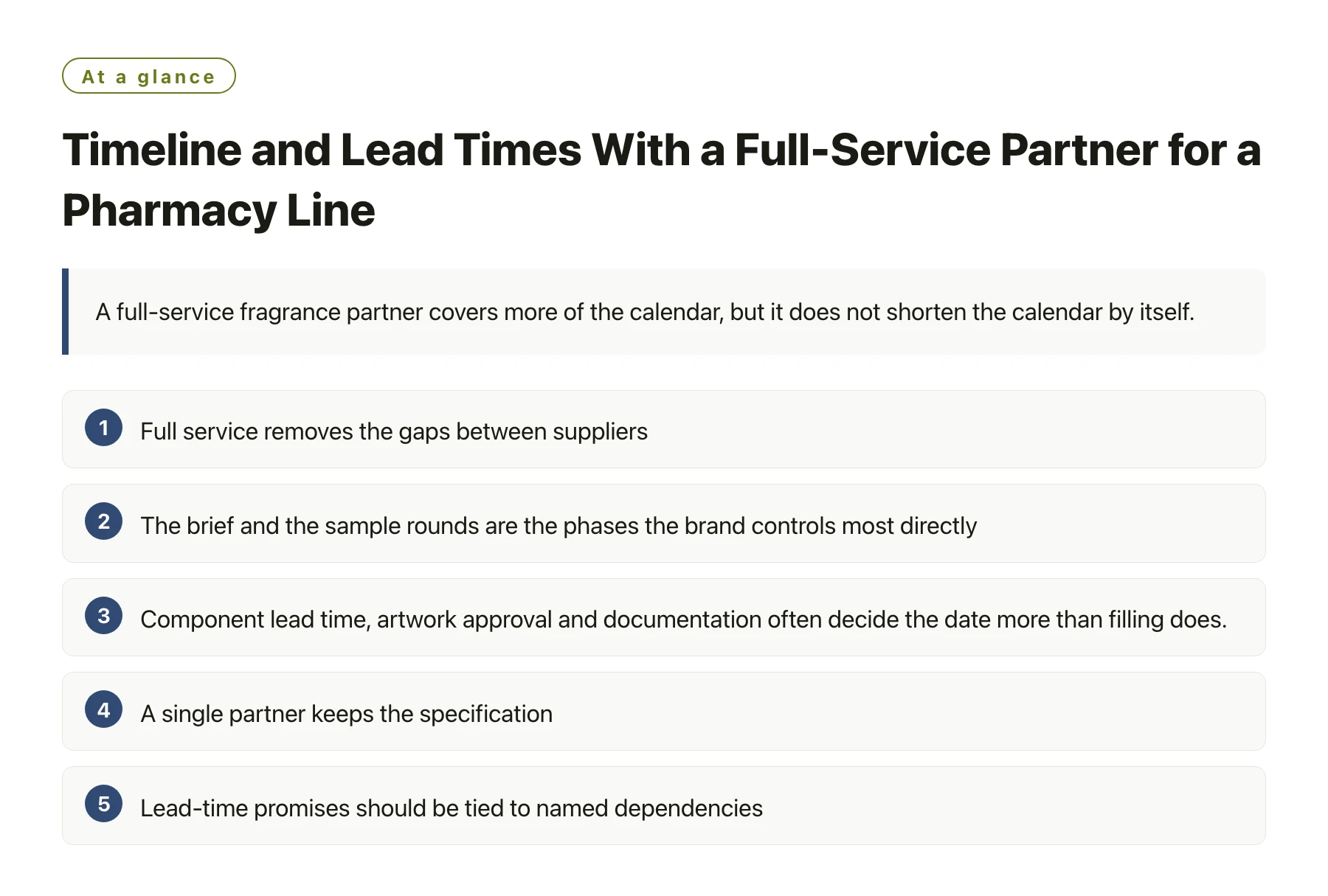
- Full service removes the gaps between suppliers, not the work inside each phase, so the saving is in handovers rather than in production time.
- The brief and the sample rounds are the phases the brand controls most directly, which makes them the best place to protect a launch date.
- Component lead time, artwork approval and documentation often decide the date more than filling does.
- A single partner keeps the specification, artwork and batch records in one place, which shortens the retailer approval step at the end.
- Lead-time promises should be tied to named dependencies, so it is clear what has to arrive on time for the date to hold.
- The last two weeks are usually inspection, packing and freight rather than production, and they need to be in the plan from the start.
The phrase full service describes scope, not speed. A partner that develops the scent, designs the pack, fills and documents the order replaces several suppliers with one, and the practical gain is fewer places for information to stop. That is a real gain: most late launches are not caused by slow production but by a handover where a specification, an artwork file or a certificate waited for someone to follow up.
Pharmacy own-label ranges add two constraints that a generic timeline tends to miss. First, the pack usually has to satisfy a retailer's own approval process, which needs documents and proofs before the goods move. Second, the range often spans several formats, and each format has its own development and testing work. Both constraints sit at the front and the back of the schedule, where a buyer's attention is naturally lowest.
The phases below describe what a full-service route looks like from brief to shelf, what the brand owes at each stage, and where the weeks are most likely to go. Durations are described as ranges and dependencies rather than promises, because the honest answer always begins with what the product and the market require.
The phases, in the order they run
- 1. Scoping and briefFormat list, market list, price tier, claims and pack direction are agreed. This phase is short if the brand arrives prepared and long if the market requirements are still being discovered. Everything after it depends on what is settled here.
- 2. Costing and quotationThe partner prices development, components, filling, decoration, testing and freight as separate lines. The brand compares options and confirms the volume plan per version. Artwork and component minimums start to matter here.
- 3. Development and sample roundsThe scent is developed against the brief, adjusted and approved. Rounds are counted, and the difference between a revision and a new direction should already be defined in the agreement.
- 4. Stability, compatibility and safety workTesting runs in parallel with component production where possible. A formula change during this phase resets part of the testing, which is why changes late in the calendar are expensive.
- 5. Components and decorationBottles, closures, cartons and any decoration are produced and printed. Lead time here is driven by tooling, print runs and minimum quantities rather than by the factory's own capacity.
- 6. Filling, packing and quality releaseThe bulk is compounded, filled, packed and released against the specification, with a batch certificate of analysis issued. Retailer-specific packing or labelling requirements are applied here.
- 7. Inspection, freight and documentationGoods are inspected, consolidated and shipped, with export documents prepared. This is the phase most often underestimated, because customs and port handling sit outside anyone's direct control.
Where the time goes, and what the brand owes
| Phase | Main dependency | What the brand must deliver |
|---|---|---|
| Brief and scoping | Clarity of the market and format list | A written brief with format, price tier, claims and timing |
| Sample rounds | Number of rounds and speed of internal approval | A single named approver and a decision within the agreed window |
| Testing | Formula stability during the phase | No formula changes once testing has started, unless a reset is accepted |
| Components and decoration | Tooling, print runs and minimum quantities | Final artwork, and confirmation of pack sizes per market |
| Filling and release | Bulk availability and packing requirements | Confirmation of retailer labelling and packing rules |
| Inspection and freight | Freight mode, route and document preparation | Timely payment terms and a decision on who books freight |
Every row has a brand-side item. That is the part of the timeline a buyer actually controls.
What full service changes, and what it does not
The measurable benefit of one partner is continuity of information. The specification that the perfumer wrote is the one the filling team reads, the artwork approved by the brand is the artwork printed, and the documents issued at the end match the formula that was actually produced. In a split supply chain, each of those transfers is a place where a version can diverge, and a diverged version found late is what turns a comfortable schedule into a rush.
What does not change is the length of the work itself. Compounding, testing, component production, filling and freight take the time they take, and a partner that claims otherwise is describing optimism rather than a plan. The useful question is not how short the lead time is but what the lead time depends on, and whether those dependencies are written into the quotation. A fragrance OEM/ODM production partner that states those dependencies openly is easier to schedule with than one that quotes a single number and leaves the assumptions unspoken. Where third-party inspection is involved, the scope and timing of the inspection are part of that dependency list, and services such as those described by SGS illustrate how verification work is scheduled alongside production. [1]
It also helps to keep the range architecture simple in the first season. Each additional format or market version adds testing, artwork and component work, and those additions land in the middle of the calendar where they are hardest to absorb. A buyer who starts with two products and one market can usually add versions later with far less disruption, which is the same logic that trade coverage of new product development tends to arrive at when it examines why launches slip. [2]
Writing the timeline into the agreement
A schedule that is going to be relied on should name the dependencies: approval deadlines, artwork delivery dates, component confirmation and freight booking responsibility. When one of those slips, the date moves, and both parties should know in advance which one it was. This is a short annex to the agreement rather than a legal exercise, and it prevents the usual argument about whose fault a late launch was.
Planning backwards from the shelf date
The practical way to use any timeline is backwards. Take the shelf date, subtract freight and inspection, subtract filling and packing, subtract component lead time and add the sample rounds on top. What remains is the date by which the brief has to be final. If that date is already in the past, the sensible response is to reduce scope rather than to compress every phase at once, because compression applied everywhere is how quality problems are introduced.
Working this way with a partner that handles one-stop fragrance manufacturing usually surfaces the same conclusion: the front of the project is where the flexibility is, and the back is where the cost is. Buyers who use the quotation to compare routes and then commit to a scope early get a more predictable launch than those who keep the scope open and expect the factory to make up the difference. The same exercise also shows why capacity questions matter, and the questions worth asking a production partner about Xuelei are a good checklist for the first meeting.
Choosing between one partner and several
One partner is usually the better route when the range is a first launch, when the brand has a small team, or when the retailer's approval process depends on documents arriving complete. Several suppliers can make sense when the brand already has a packaging supplier it trusts, or when a specific component is only available elsewhere, provided someone owns the coordination.
The cost comparison is rarely as simple as unit price. A full-service quote may look higher because it includes work that a split chain leaves to the brand, while a split chain may look cheaper until the internal time and the delay risk are counted. A partner that has run a range of projects across formats, as Xuelei case studies tend to show, is often able to say where a split is workable and where it is not, which is more useful than a general preference for either model.
Whichever route is chosen, keep the document set and the schedule in the same place. A pharmacy range is approved on paper and delivered on a pallet, and the two have to agree.
Sources
- SGS: Cosmetics, Personal Care & Household Testing —— Testing, inspection and certification services for cosmetics and personal care, including microbiological, stability and safety testing aligned with cosmetics GMP.
- Cosmetics & Toiletries —— A technical magazine for cosmetic formulators, covering ingredients, formulation science and testing methods.
Frequently asked questions
Does using a full-service partner shorten lead times?
It shortens the handovers between suppliers, which is where avoidable delay usually sits. The production, testing and freight work itself takes the time it takes, so a full-service route improves predictability more than it compresses the calendar.
Which phase is most likely to slip?
Sample approval and component artwork are the two most common. Both depend on brand-side decisions, and both block several later phases at once, which is why naming an approver and a deadline matters so much.
How far ahead should a pharmacy own-label fragrance be planned?
Plan from the shelf date backwards, including freight, inspection, filling, components, testing and sample rounds. The required brief date usually falls several months before the shelf date, and the number depends on how many versions and formats the range includes.
Can testing run at the same time as component production?
Often yes, provided the formula is frozen. Changing the formula during testing usually invalidates part of the work, which is why late scent changes are the most expensive kind of change in a project.
Is one supplier always better than several?
No. A single partner reduces handover risk and keeps the paperwork together; several suppliers can be preferable when the brand already has strong packaging relationships. What matters either way is that someone owns the coordination and the document set.